Your shopping cart is empty!

MENU
-
Quad Bikes+
-
Dirt Bikes+
-
Scooters+
-
Fitness+
- E-BIKES +
-
Ride On's+
-
Cycles+
-
Kids Play+
- Baby +
-
Sports & Games+
- Sale +
Your shopping cart is empty!
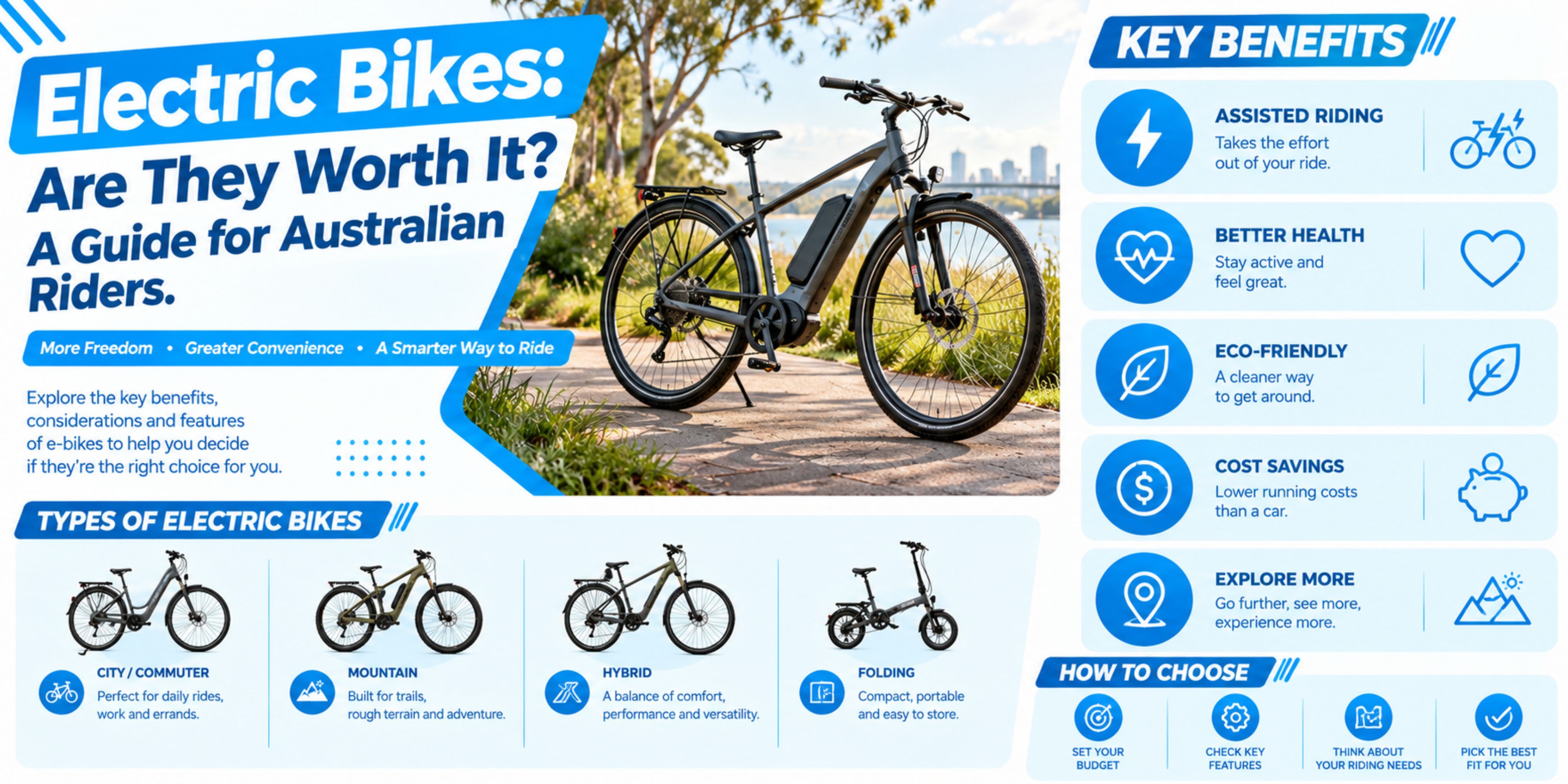
Many Australians are asking if a battery-assisted ride is worth their money because of rising fuel costs, tricky parking and steep hills. An electric bicycle is a regular bicycle that has a small electric motor attached to it to give a boost every time you pedal. This helps to reduce hill reps, maximise distance and minimise sweaty finishes. This informative guide breaks down all the benefits, cost, and rules, so you can figure out if an e-bike is for you and your budget.
Yes, for the majority of riders. There's one thing behind the rising popularity of electric bikes Australia-wide, and that's the motor eliminating the obstacles to cycling. See the full cycles range to compare e-bikes to standard commuter, mountain and kids models.
Here are some factors to consider before making a decision:
In addition to being cost-saving, here are the benefits that riders can enjoy when using an e-bike for everyday commutes.
Hill climbing and pedalling against strong wind help you maintain your power. Even for the new rider, longer routes seem attainable, and you choose your level of assistance.
It costs much less to charge than fuel for a car. Compliant models don't require a license or registration, saving on annual costs, and service requirements are similar to a conventional bicycle.
You continue to cycle, so you continue to benefit from the low-impact exercise. It is less impactful on the joints than running, convenient to fit into your day, and it helps ease your way back into fitness.
The bike lane or path will outperform peak-hour congestion. You can get to the car park in no time at all, and going from door to door can be quicker, particularly in congested urban environments.
There are no exhaust emissions at the tail of an e-bike. It is a cleaner alternative than car travel for short trips, quiets down local noise and means you have a reduced carbon footprint every day.
The sweat-drenched shirt stays out of the equation, the hills are tackled at a comfortable pace and car parking is avoided.
Range varies based on battery capacity, rider weight, path and assistance type. A mid-range battery should perform for about 10 - 15 km a day, usually a commute to work, which is best accomplished at your workstation or at night at home.
You should be wearing a helmet and have light panels on the front and back to make it easier for the driver to see you. Install a solid lock for parking, and a rack or a pannier for carrying your laptop and lunch.
Before you purchase, go through this checklist:
| Factor | What to look for | Why it matters |
| Motor | 250W, pedal-assist | Meets Australian rules for bicycles |
| Battery | Larger capacity (Wh) for longer commutes | Determines real-world range |
| Brakes | Hydraulic disc brakes | Better stopping power with extra weight |
Because rules for electric bikes Australia-wide can differ by state and territory, check with your local road authority before riding. Key points to know:
Go Easy Online's electric bicycle range covers urban, cargo and step-through styles.
The Progear E-Mode 53cm Urban Electric Bike has a 53cm urban frame suited to daily commutes and errands. It is a straightforward city option for riders who want simplicity, and a sensible starting point if this is your first e-bike.
The Shogun eMetro Urban Electric Bike comes in several frame sizes, so you can match it to your height. It suits city riders who value a comfortable, correct fit, especially on longer weekday commutes.
The XDS E-Conic S2 17" Ladies E-Bike – Lavender is a ladies' model with a 17-inch frame in a lavender finish. It is a stylish pick for riders who want comfort and colour from the same bike.
Know how you want to ride first, then check out this electric bike buying guide to narrow down your options. If you're looking for smoother e-bike commuting or weekend rides, properly fit the bike before heading out. Once you are ready, browse the e-bike range and discover your perfect ride.
Not for models that are compliant. A 250W e-bike equipped with a pedal assist, and rated at no more than 25 km per hour, is typically classified as a bicycle.
This can depend on the battery, slope, rider weight and assist setting. There are several commuter models that have a range of 40km to 80km.
The motor makes it smoother over hills and on long distances, so rides are smoother and beginners stay on the bike.
Just like a normal bicycle: inspect tyres, chain, brakes, and battery on a regular basis.
Yes, many are designed for wet weather, but do not pressure wash electrical components.


