Your shopping cart is empty!

MENU
- Eofy +
-
Quad Bikes+
-
Dirt Bikes+
-
Scooters+
-
Fitness+
- E-BIKES +
-
Ride On's+
-
Cycles+
-
Kids Play+
- Baby +
-
Sports & Games+
- Sale +
Your shopping cart is empty!
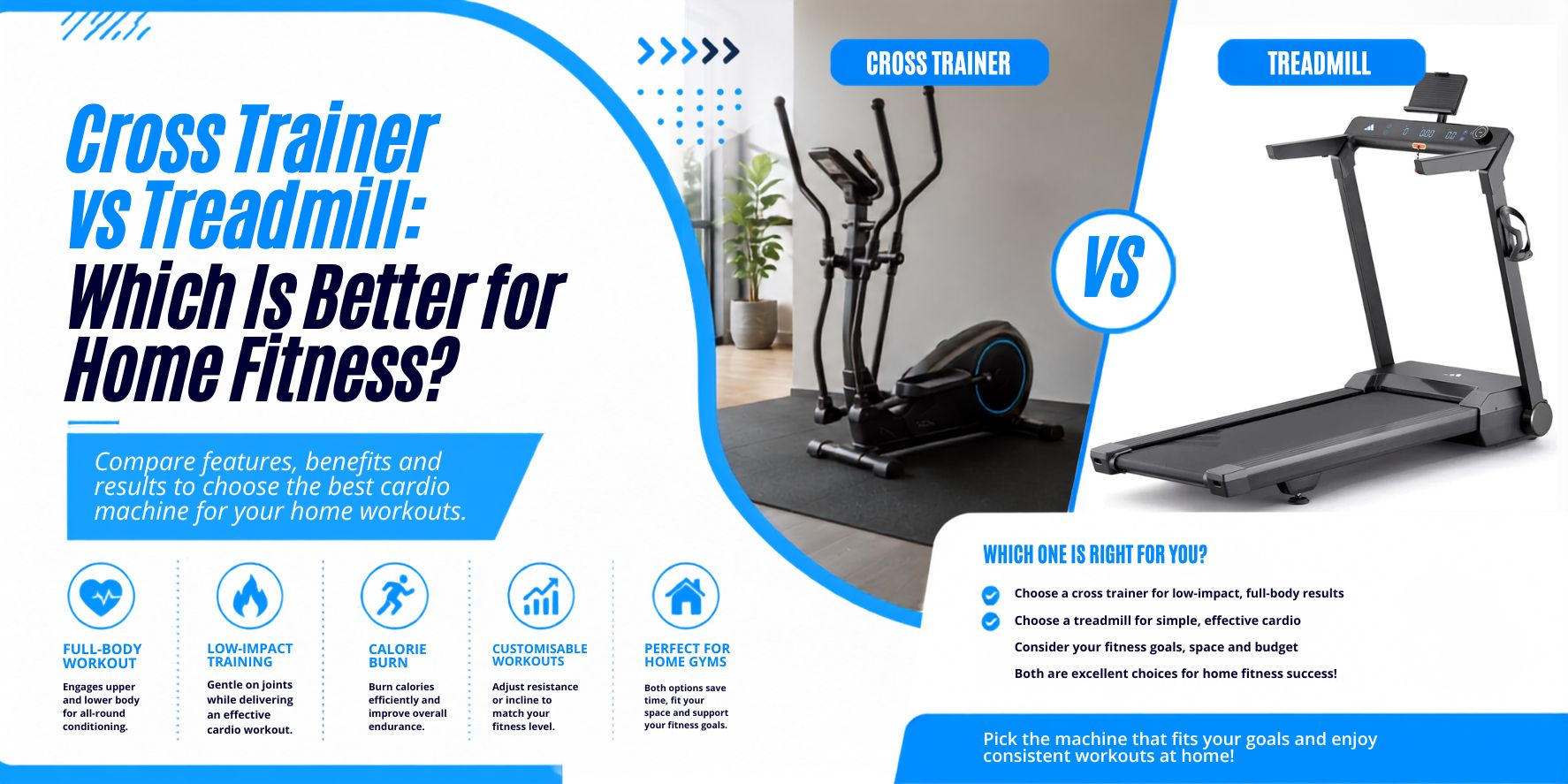
Treadmill and cross trainer both promise a solid cardio workout at home, and that's exactly why the choice feels confusing. Here's the thing: the right answer isn't about which machine is "better" in general. It's about what you actually want out of your training. Walking, jogging, running that's treadmill territory. Want something smoother, lower-impact, and working your arms along with your legs? That's the cross trainer's job.
Lets take a closer look and learn the difference clearly between a cross trainer and a treadmill. It will help you make the choice of getting a treadmill or a cross trainer for your workout a lot easier.
Before you buy treadmill online, think about how you'll actually use it day to day. A treadmill recreates the exact motion of walking, jogging, and running. A cross trainer moves differently, somewhat like a smooth, elliptical motion, with feet locked onto the pedals the whole time. Both build cardio fitness. The experience of using them, though, is nothing alike.
Your feet never leave the pedals on a cross trainer. However, a treadmill just mirrors the movement you'd naturally use outside.
Sometimes running just isn't the priority. Comfort is. Joint-friendliness is. That's when a cross trainer earns its place. The smooth, gliding motion spares your body the repeated pounding that comes with running, and if the model has moving handles, more of your body ends up working during each session.
Take the LSG CTG-300 Cross Trainer, the Orbit Fitness Orbit Flo Stride Cross Trainer, or the Lifespan Fitness X-23 Cross Trainer. Each machine has different preferences, but all deliver the same smooth, low-impact cardio experience.
Choose a Cross Trainer If You Want:
Lower-impact cardio.
A workout that involves your arms and legs.
Comfortable longer sessions.
A break from repetitive running.
A versatile option for general fitness.
If you love running outdoors, or you're chasing better endurance, the treadmill's movement pattern makes it the obvious pick. Which? backs this up too, noting that treadmill training pays off specifically when your goal is improving your outdoor walking or running.
And modern treadmills don't just do one thing. Bump up the speed for intervals. Add incline for hill work. Or just walk at an easy pace while you catch up on a show.
Want something simple? The Adidas T-23 Treadmill covers the basics well. Tight on space? Go with the Adidas T-24c Folding Treadmill. Chasing incline training specifically? The Adidas T-800 High Incline Treadmill handles that. And if you like a more connected, tech-forward setup, the Lifespan Apex Smart Treadmill fits that bill.
Beyond that, the right model comes down to your space, the intensity you're training at, user capacity, speed range, incline options, cushioning, and how much storage you've actually got.
Neither one wins this automatically. Both machines can support weight loss but the machine itself isn't really the deciding factor. Your activity level, your workout intensity, what you're eating, and whether you actually stick with it matter far more than the equipment.
That said, a treadmill can pull ahead during hard running or steep incline sessions, simply because you can crank the intensity up so much. A cross trainer holds its own too, it's plenty demanding, and because it's lower impact, some people find they can go longer on it. So don't ask which machine burns more calories. Ask which one you'll actually show up to use.
Use either machine consistently, and your cardiovascular fitness improves. The real question is what kind of fitness you're building toward.
Training to walk or run better? The treadmill has the edge. You can gradually push speed, distance, and incline as you go, and interval training is simple to set up.
A cross trainer challenges you differently. Arms and legs working together turns it into a genuine full-body session, and adjustable resistance means you control exactly how hard it gets.
Building a home gym? Either machine can rightfully claim the title of best home cardio equipment. It just depends on what you're training for.
Walk it off after a rough day at work. Jog at an easy pace. Run intervals. Crank the incline when you want more of a challenge. Recent fitness coverage backs this up too, pointing to incline walking specifically as a smart way to raise cardiovascular demand while working your glutes and hamstrings.
Cross trainers bring something different to the table. That smooth motion makes longer sessions genuinely comfortable, and moving handles pull your upper body into the work. They're also a solid option when you want good cardio but don't want running to be the centerpiece of your routine.
Start with your space; it matters more than people think. Measure the area before you buy anything, and don't forget to leave clearance around the machine itself. A folding treadmill helps if storage is tight, but you'll still need enough room to actually use it safely.
Your goals matter just as much as your square footage.
There's no single winner in the treadmill vs cross trainer debate. It depends entirely on you. Want natural walking and running movement, incline training, or a machine that carries over to outdoor running? Go treadmill. Prefer smooth, low-impact movement with more upper-body work built in? Go cross trainer.
Think honestly about the workouts you'll actually look forward to, week after week, not just this month. The machine that fits your goals, your space, your budget, and your routine is the one worth putting in your home gym.
Is a cross trainer better than a treadmill?
It depends on what you need; want low-impact, full-body cardio? Go with the cross trainer. Training for a run or want incline work? The treadmill wins there.
Which burns more calories, a treadmill or cross trainer?
Push hard on a treadmill and you'll likely torch more calories than a casual cross-trainer session. But intensity, time, and your own effort matter just as much as the machine. Stay consistent and either one supports weight loss.
Is a cross trainer good for losing belly fat?
It helps with overall fat loss by keeping you moving and burning energy. Spot-reducing belly fat with one machine? That's not how the body works. Diet and consistency do the real heavy lifting.
Can I use a treadmill every day?
For most people, yes, especially easy walking sessions. Daily high-intensity running is a different story; that wears on the body faster. Build up gradually instead of diving into tough workouts right away.
Which is better for knees, a treadmill or cross trainer?
Cross trainers are easier on the knees since your feet stay planted on the pedals. Treadmills, especially during running, put more impact through your joints.
Is 30 minutes on a cross trainer enough?
For a solid cardio session, yes, as long as you keep the intensity up. Your fitness level and goals shape what's "enough." Showing up consistently beats grinding through marathon sessions.


